
Showing posts with label question interviews. Show all posts

Friday, April 25, 2014

A Ton Of Question... and these were from friends


     *A couple months ago I asked a couple friends to send me any question and I would answer them in an interview on my blog. Below are these questions. I mixed all of them up to add to the chaos. In a case of me over thinking everything I thought about answering each one with a meme but in the end decided against that because that's a lot of cut and pasting.

What inspired you to write your first book?
My first book Stereo which was renamed Stereo 2.0 and now is considered Tin Universe Monthly #1. Well, it was written as my attempt to try and capture the feel of a 1980’s comic book company crossover events such as Atlantis Attacks or Mutant Massacre. The only problem was I wasn’t good enough at the time to move the pieces together in a way that fit. I’m proud of it because I learned so much but my ideas of what I wanted from it where bigger than my abilities at the time. I wanted it to be a big crossover type event that was also the introduction to the Tin Universe.
What is your biggest failure?
As a writer? Yes. I want to be totally honest answering these so I would probably say the first time I attempted a monthly Tin Universe series. I just tried to write everything from scratch each month. This time I spend two years writing the zero and 1st drafts of a number of future projects and among those writings was the zero drafts of three years’ worth of Tin Universe Monthly.
Do you have a writing style?
No. Not unless you think dumping every thoughts that’s in you head at the time of writing on a page and then trying to clean that up and make sense of it is a writing style…. Wait, that’s more of a writing process.
My writing style as I’ve said before is tangential writing.
Do you have any recurring dreams/nightmares?
I only have nightmares. Let me think??? One recurring of late has me finding a job that pays ok. This is a case of a good dream being a tortures nightmare because it’s not reality; which is pretty much how all my dreams go.
Is there a message in your stories that you want readers to grasp?
Think.
What is the biggest lie you've ever told?
Telling myself for a long time that I shouldn't call myself a writer was very harmful to me in many way as a writer and outside of writing.
What books have most influenced your life most?
Good question.  So this doesn’t become a favorite books list I just say three. The X-Men comics, Hitchhikers Guide To The Galaxy, and Frankenstein.
Have you ever been in trouble with the police?
As an adult beside a couple tickets, no.
What book are you reading now?
Captain America And The Falcon: The Swine, Attack On Titan: Vol.1, Doctor Who: The Wheel Of Ice, and Lemony Snicket File Under: 13 Suspicious Incidents.
Have you ever gotten into a bar fight?
I would tell a story here but I’ve forgotten what is fact and what is fiction in the story so I’ll just not answer in answering.
Are there any new authors that have grasped your interest?
Depends on what is meant by new authors. I’m just now getting into the writing of Kelly Sue DeConnick and  Marjorie Liu.
What is your biggest fear in writing?
I guess because I edit my own work there is a fear that people won’t see how much effort I’m putting in. I don’t mind putting my work out there is a sort of raw sate but as I’ve told people even writing shit takes a lot of work.
Name people that you feel supported you outside of family members.
Damon, Neka, Courtney, and so many others because most people might be complete shit but there are also good people.
What do you want your tombstone to say?
I said this on my Facebook once. When I die I want my tombstone to read: HAD STORIES, TOLD THEM.
Do you recall how your interest in writing originated?
From being a sick kid who spent a lot of time in hospital bed reading and thinking.
If you had a superpower, what would it be?
Teleportation.
Is there anything you find particularly challenging in your writing?
I found I wasn’t improving any in my writing until I decided I was going to purposely challenge myself with everything I write. Now if you mean what challenging for those reading my writing I’d say understanding it. Believe me it’s hard for me to understand what I write too.
Who is your favorite author and what is it that really strikes you about their work?
My favorite writer is Douglas Adams. I think what attracts me to his writing is this sense of him being a smart ass telling the story to the reader.
What literary character is most like you?
Mar has said I’m a cross between Charlie from Perks Of Being  A Wallflower and Fry from Futurama with bits of Bobbie Hill from King Of The Hill and Randal from Clerks thrown in.
Who designs the covers to Tin Universe Monthly?
I do. I’ve loved doing the covers this year as the theme for the main series being that of propaganda posters and the ads being the posters posted in different places. I would like to hire artists for the covers or hire cosplayers for photo covers in the future but mainly my covers are by me using my own photos or public domain images. I’ve also been lucky this year that some friends helped me by modeling or using some of their photos. I have some really good ones coming up soon. I think I’ve improved a lot doing covers and using programs like Gimp, and have had a lot of fun doing them of late even if its extra work for me, it’s also one of the biggest reasons for self-publishing in that you get to control the images that go with your stories.
What secret talents do you have?
I’m pretty good at finding the sweet spot of as Mar says “That got real quick.” This sort of thing always reminds me of how people from time to time say they like that I’m totally open on the internet. No I’m not. If you think I’m offensive and stupid on the net there is another level I’m on offline and then even another when I’m just with Mar.
Where is one place you want to visit that you haven't been before?
I would love to go to London because I know how happy us going there would make Mar.
What were the challenges in bringing Tin Universe Monthly to life?
The challenge every month is trying to make a vignette or flash fiction story something that people find interesting even if they aren’t always complete stories. Sometimes I succeed sometimes I fall flat on my face but have to get right back up to fight again doesn’t give you time to swim in your own bullshit.. The smaller a story is, the harder it is to get a point or idea across. Short Stories are way harder to write than a book, that’s a lesson learned. That’s the challenge in doing these. The series is to world build in laying down layer upon layer so when the next book comes out if you have read the series you will get even more from the book, though I’m also working hard on the next full Tin Universe adult book to be a story that you can enjoy without reading any of the monthly single issues.
Do you have any strange writing habits?
I don’t think so. I know I hate writing in silence, even though editing in quite is best. When I’m writing I need noise to cancel out my back brain so to speak. My back brain being every mistake I’ve ever made in my life in chorus form.
Do you have any scars?
Yes. Some from self-harm and others from stupidity. And others I was just born with.
What authors have inspired you to write?
Douglas Adams, Robert Holmes, Nova Ren Suma, Grant Morrison, Gail Simone, Courtney Summers, Neil Gaiman, Warren Ellis, and Margaret Atwood to name a few.
What is something you want to accomplish before you die?
Get a new job. Have a day without a lot of pain. Write something with one of my favorite writers.
How important are names to you in your books? Do you choose the names based on liking the way it sounds or the meaning?
I really don’t think much about character names. Normally I just pick first and last names at random and match them together. Usually when I try to think much about them I choose things I later regret when I have to write it over and over and over and over again.
Do you read your reviews?
No.
Do you drink?
Yes.
Smoke?
No. I have asthma and even I’m not that self-destructive.
What is your best marketing tip?
I suck at marketing. I know it’s something I need to work on to get word out there in more places about my releases. That’s why I started doing ad images for Tin Universe Monthly releases. Give people each time something different to see as almost teasers to what’s coming and it keeps people from getting a spamming feeling when I promote something. I want to do flyers and such also in the future but it’s all about balancing things because the stories must remain the main focus.
Do you write naked?
Nope. Though I did read once of a writer who masturbated before writing to clear his mind. But no. I actually have taken up the habit of taking a shower and dressing as if going to work before writing, sets my mind in the right direction.
What were you like as a child?
A sickly self-absorbed pain in the ass who thought he had all of the answers.
Is there one subject you would never write about as an author?
In college I wrote two books that I’ve never let anyone read but I do plan to publish one day. One was as I rewrote the Bible and the other was a pro serial killer first person book.
Is there a certain type of scene that's harder for you to write than others?
Action scenes I find really hard but I’m trying to find a way to give a feeling of action through the words but I’m starting to think over described action scenes are as bad as anything else over described.
What are you working on now?
Tin Universe Monthly, Generation Of A God, Tin Universe, Middle Grade Series #2, and another book project are what I work on every day, every week, every month.

you might want to check out,
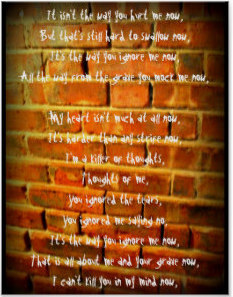
      This poster is in honor of Sexual Assault Awareness Month. Created from poetry written in 2010 by me to draw attention to the issue, it has been paired up with a photo from Stainless Photography. Any profits made from sales of the poster will be donated to a local Melbourne Florida charity that helps people who are dealing with sexual violence issues.


     Someone is zombifying athletes at Clear Cut High School in Utah. Lucky the school has its own young superhero in the person of Mildred Betbeze to try and figure out what's going on. Pep rallies, cheerleaders, new kids in the neighborhood are just some of things our hero and her sidekick slash best friend Aisha have to deal with in the first book in Tin Universe's new middle grade series.


Share/Save/Bookmark

Saturday, October 23, 2010

TECHNOLOGY AND THE ARTS INTERVIEW SERIES #3: DAMON FORD

I’ve known Damon for a number of years. An admirer of the way he thinks and someone I have and always will consider a friend and so when I decided I wanted to finish this three interview series talking to a consumer of the arts and new technologies, the first person that came to mind I wanted to send questions to was Damon. I’ve never talked to Damon about any subject without coming away from the conversation thinking from different lines to what we talked about.

-Damon, thank you for taking time out of your day to answer some questions.

*You’re welcome. Despite some initial surprise at being asked, I’m happy to try to articulate some of my thoughts here.

-Over the time I have known you it seems like you have always had a interest in how technology effects us all and this series of talks deals with technology and the arts; so, to start how about you give us some insight in how technology has changed how you encounter art and how you consume it in your life?

*To start, technology has certainly made art more accessible. Whether that be through purchasing a DVD, reading something online, buying a book that is not released locally (or even just finding out about artists that don’t release / have a presence locally) – technology levels the playing field.

Recently, a New York Times article highlighted a marketing position of some publishers to give away e-books on the kindle. Distribution / publication costs are minimal, so in some respects makes sense. But it also reinforces that ‘e’ is also a code for ‘free’, and there are a generation of consumers that consider online content is, or should only be, free. And for this, content providers really only have themselves to blame. I have, and will continue to pay for content that is valuable to me online, and in some cases would start to pay, if the content provider actually started charging for their content. I just don’t follow the logic of giving content away online, but charging a premium for that same content being in print.

Perhaps this legacy has come about from the fact that just getting online has traditionally cost quite a bit of money (and while falling rapidly is still generally not ‘free’) - content providers have in the past faced a challenge getting people to pay again once they are online.

Of course, people will (and do) pay when the content is packaged in a way that the consumer values – witness iphone / blackberry apps (and ipad ones), or when the content is time sensitive, like the markets data and analysis of the Wall Street Journal or Financial Times.

Working out just what consumers will pay for online, how much, and in what delivery form, is going to be one of the big challenges of the next several years. And personally, I have no idea what the successful models will end up being – that is something for others to work out.

- I remember us once discussing pdf books and reading on handheld devices. How often have you read materials of any length on an handheld device? Do you see this becoming more and more the normal fashion for artists to communicate with their audiences?

*I’ll admit that as a primary medium I prefer print, even when I have to wait a week or so for delivery of print editions of international magazines that I subscribe to that also have free online access for subscribers. So, while I will peruse the tables of contents, and perhaps look at some online only content, when it comes to reading / interacting with a text, I like the tactile involvement of words on paper. And I’m prepared to pay for it, because it is of value to me.

However, I say this at a time when e-books / e-reading is in its infancy, and the devices for reading content are, to be honest, less than impressive. A friend had me order a kindle for his wife as a Christmas present, which was both wanted, and eagerly awaited. And then, on Dec 26 I was asked to help out, because they could not get the kindle to connect to a wireless provider. A google search gave me the information I needed to help out, but it was not an intuitive solution, and even knowing what I had to do, it still took over half an hour on the kindle to make it work.

The challenge that technology companies are going to have to overcome in bringing e-readers and their associated technologies to market is that there is still a significant proportion of the community that is not comfortable with these sorts of products, and don’t understand why they don’t just ‘work’. And when you’re experience is opening a book or magazine and not having to fight the medium to get content you had paid for ….

So, while e-reading has potential, there is much work to be done on the devices, and the software running them. I have every intention of ordering an Ipad, because I’m curious to discover if it has the potential to change the way I read / purchase content. I have a feeling that in time it will, but perhaps not with this initial release of the product. I definitely see a substantial change in the way publishers will have adapt to these new products over the next 6, 12 and 18 months.

-Reading or viewing art forms, which do you prefer in a non-personal way(though personal may not be the right way of saying it): Website, email, pdf, all?

*For reading, I like pdf, and always have. It’s all about the visual for me, and pdf fonts / layout just seem much more readable.

-Do you believe technology is an advancement with bumps in how it mates with art or is technology an enemy of the artist and art itself? This is a question I've asked several artists and I was wondering about the view from someone who is sort of an outside view on art as you like to say you are not an artist. Though in my eyes everyone is artistic, I consider intelligence artistic.

*I would consider technology to be a provider of opportunity, and how the artist uses (or chooses not to use) any new technology would I think be made on an individual basis. Technology need not be an advancement per se – it’s more about a different way of doing something – and I think that art grows with every new way there is to present an idea.

-Since we are both of the age that technology was beginning to really grow in its modern fashion during our youth to how it stands today, do you think you enjoy the way art is presented now over then when you where younger?

*I consume a lot more art now, thanks to the internet, especially in the sourcing obscure music, movies, tv shows, books etc. I remember back in the mid 1990’s when I first ordered cd’s online – the idea that I could source music of artists that I wanted but which were not released locally was both amazing and addictive. It’s those initial feelings of wonderment in the sudden expansion of opportunity that was presenting itself that I have never forgotten. And I don’t think we should ever forget that. And even now, every time I order something online it amazes me that, within a week or so, it will arrive at my door, and I didn’t have to go anywhere for that to happen.

So in the sense that ‘presented’ means ‘available’, I certainly enjoy things now.

Damon has worked with NSW Department of Human Services- Ageing, Disability & Homecare. He attended the University Of Wollongong class of ’93 and ’98: ’93 Primary, Bachelor of Education. ’98 Special Education, Master of Education.

Picture provided by Damon Ford.
Interview questions by Brian C. Williams
Share/Save/Bookmark

Wednesday, September 22, 2010

TECHNOLOGY AND THE ARTS INTERVIEW QUESTION SERIES #2: Lea Hernandez

Welcome to the second of three interviews were I have sent out questions to several people about the connection between technology and the arts. I picked the three best interviews and I’m presenting them now and hope you enjoy reading these answers.
The subject of technology and the arts is one I’ve always had a vested interest in, from making fanzines on copiers when I was in high school to connecting with people through the internet on blogs and the other opportunities the internet can offer up to artists. But with those opportunities for artist to grow and shine, technology has also always been a double edged sword for the artist and the consumer also with pirating hitting artists and consumer fraud for those purchasing the works of artists. I hope to get a better understanding from this series of what is being felt on the subject not just by me but by others. I also hope you enjoy reading these interviews as much as I have as they have come into my inbox.
With this interview I get answers from Lea Hernandez

Lea Hernandez is a twenty-plus years comics veteran who has published in traditional print and led the charge to publish comics on the web. Her graphic novel series include Texas Steampunk, the tart pop satire Rumble Girls (the first print comic series to move to the web) and the 90% true Near-Life Experience. Her comic, "Ribbons Undone" was part of the Eisner and Harvey Award-winning "Comic Book Tattoo" anthology.


She is currently writing and drawing a new middle-grades series, "The Garlicks," and publishes "Near-Life Experience" weekly-ish at divalea.livejournal.com. She also does lots of work hidden deep under layers of non-disclosure agreements.

Lea is a single mom of two teenagers, and lives in San Antonio, Texas.


QUESTIONS FOR LEA HERNANDEZ

-Hi Lea! Thank you so much for taking time out of your busy schedule to talk to answers some questions! I will try to keep these short but cover as much as we can. With your work with Rumble Girls in mind do you believe things are headed in the right direction for artists when it comes to technology?

*Absolutely, you can connect with an audience without an intermediary and keep costs down. Having been in comics since the black & white boom where getting one's work out meant paying for printed books, convincing the distributors to carry you, hand-selling to stores who only had what distros fed them, and a lot of road time to build an audience, GOD DO I LOVE THE FUTURE. The old way was expensive, difficult and frustrating. It sucked.

-I have enjoyed viewing some of The DivaLea Shows you have done. What made you decide to do this?

*It's the kind of thing I like to watch: someone's drawing process with smartassery. I love commentary tracks and making of documentaries and short subjects.

-Have you ever gone the pdf route or considered doing so with your work? Any big reasons for or against? This is my preferred way of getting my work out but I know others have problems with going that way.

*I've thought of it, but never had the time to pursue it. There will be paid digital distro for some of my work in the near future.
Let's turn this around: why do you prefer PDFs? Ease of reading? (Not having to click endlessly through online archives.) Ease of distribution?

-I prefer PDFs because one, you can get a large amount of materials out there pretty quickly. Another is the money you can save. The only thing I spend money on is for cover artists and editors and then share profits with LuLu who I publish my PDFs through. 
The main reason I started  in the begining releasing stuff as PDF was during a time when I was sending free short stories and poetry collections to friends by email. The PDFs could be read on most computers without screwing up my formatting.
The main reason I’m doing it now to be honest is because I’m still learning the craft. I handled my learning disability and the diffcultity it gave me when it came to writing with anger for years and that slowed my progress down. If I had thought my first book was good enough I would have tried print publishing but it wasn’t. When my 2nd book is full and complete I will look it over also and make a decision but as long as I’m inproving and getting better that is my biggest goal. PDFs and internet release lets me release projects as my learning process keeps going, get feedback, and it not cost me tons of money…which I don’t have anyways.
Isn’t it great no one wants to interview me, I just ramble.

-With piracy issues for every form of art when it comes to technology at large and what seems to be a twisted view by some that all things should be free do you think the pros will out run the cons when it comes to the effects of technology and the arts?

*I think the pros still outrun the cons. I also think there are people who, even if given something for free, would STILL steal it, because it's not about having, it's about GETTING. They steal because they can. Some of them are childish, whiny, entitled and impatient. Others are convinced they're sticking it to "the man," whoever the man is. The man is certainly not the artist whose work is pirated.
OTOH, creators need to, as much as possible, identify the people who steal their work because their books are hard to find, to get readers to buy online, get from libraries, buy at shows.
Comickers are in a position to have more direct contact with their audience than prose writers. It's a business that has a lot of hand-selling. So, it's easier to follow this route. By which I mean other than comics and Cory Doctorow, I may be talking right out of my ass.

-Here is my off the wall questions. Is technology like Twitter helping more artists or hurting them?

*It depends. There are days when I love Twitter. There's this good flow, like I'm giving a talk, or doing a stand-up act 140 characters at a time. There are also days when Twitter depresses the fuck out of me, when I have gotten a rejection or work or the personal life is going poorly, and things for others seem (the operative word is "seem") to be going fantastic. Then Twitter can be pure poison for anyone.
It can be another excellent online procrastination tool, like web forums, and newsgroups and AOL and Compuerve...
On the whole, I find it fun and it's wonderful and there's an instant gratification that helps motivate creators who usually work in a vacuum. It's a great way to connect. I am fascinated by the way it's shaping lives and events in its tiny bites.

-Anything you want to promote?

*I'll be appearing at MangaNEXT (http://manganext.org/) as a guest, likely running a workshop on story conception, and a panel that is unlike anything done at an anime/manga convention.
I'm currently writing and drawing an all-new middle-grades comic, The Garlicks. Think a supernatural "Romona and Beezus."
I also put up a sketchnote comic, "Near-Life Experience" once a week-ish at divalea.livejournal.com. NLEx has been running off and on since 2003. It debuted with the launch of Modern Tales.

-Thanks Lea, and again Thank You for taking part in this series and answering these questions.


The next Interview in this series will be posted on October 22 as I ask Damon Ford questions about art and technology.


And as always support your local comic book store, Mine is Famous Faces And Funnies
Share/Save/Bookmark

Sunday, August 22, 2010

TECHNOLOGY AND THE ARTS INTERVIEW QUESTION SERIES #1: COLLEEN DORAN

Welcome to the first in a monthly series of question interviews I have sent to several people about the connection between technology and the arts. The subject of technology and the arts is one I’ve always had a vested interest in, from making fanzines on copiers when I was in high school to connecting with people through the internet on blogs and the other opportunities the internet can offer up to artists. But with those opportunities for artist to grow and shine, technology has also always been a double edged sword for the artist and the consumer also with pirating hitting artists and consumer fraud for those purchasing the works of artists. I hope to get a better understanding from this series of what is being felt on the subject not just by me but by others. I also hope you enjoy reading these interviews as much as I have as they have come into my inbox.

To start the series we are starting with an artist I respect not just for her art but also for her views on issues of creator rights, piracy, publishers, and the harsh realities self-publishing can hit you with.

Colleen Doran was a name I first discovered in my local comic book shop when I was in college and looking for any comics outside the big two. What I found was A Distant Soil and though I fell away from reading comics for a few years, a year or two ago I discovered her website and now I’m falling for the beauty of the story which is one of the best space epics I have ever encountered once again.

For more detailed information on Colleen check out her ABOUT page on her website:

The answers to all questions are presented right from the emails I received.


QUESTIONS FOR COLLEEN DORAN


-Hi Colleen! Thank you so much for taking time out of your busy schedule to talk to me! I will try to keep this short but cover as much as we can. You have seen many changes in publishing in the comic industry being one of the people right there at the forefront of the independent shakeup to creating an internet presence for yourself through your blog and now having your series A Distant Soil appearing on your website, Do you believe things are headed in the right direction for artists when it comes to technology?

*Not when the primacy of the author is not respected. We need to instill in people the importance of supporting creators and their work. This myth that all creative artists are rich spoiled brats is pervasive. That they ought to be grateful for just having someone look at their work. It's nuts. That's like telling a cook he ought to be grateful for making a fine meal, or a doctor he ought to be grateful for being given the opportunity to heal. This is a job. It is hard work, it usually takes many years of study to excel, and few ever make any money at it. The average artist makes less per hour than a day laborer.

And art isn't free, even for the creator. It costs money to produce the work. It costs money to buy the supplies. It costs money to live while you are making the work.

Where is that financing going to come from if people think all art is free?
Information is free, but art and entertainment is not.

I find it interesting that even some of the internet gurus like Jared Lanier have rethought the matter. The copyleft movement isn't working out like they planned.

-You have always posted entries on your blog about artist rights, health benefits, and many other areas of great interest. You have made your blog such a friendly place for artists to find information that is helpful. Is it ever overwhelming having so many people seeing you as someone who can help?

*Unfortunately, yes. I spent the last weekend clearing out about 620 emails. I still have 180 to go. I can't answer them all personally anymore, and some people have very unrealistic expectations about what I can do for them. Sometimes they get hostile if they don't get an answer right away or if I don't have the magic formula for their problem. It can be stressful. But it's very satisfying when I do get to help someone.

I hope to help people help themselves. I don't want to be a guru. I want to give people tools, or point them in the right direction.

At the same time, I don't think some of the fans realize how much time and effort I put into this. I spend hours writing some of these articles that also take time to research. They are read by thousands of people, and they make a pittance. I do this as a public service, but

I have no choice but to be frugal about who gets my time and who doesn't.

If I encounter someone I think will excel, I will go out of my way for them because I think there will be a tangible return on the investment. And that tangible return means the future of their career. I want to see people do well. Not everyone will do well. I make a judgment and proceed on that judgment. It is entirely subjective, and I make no apologies for those choices.

I am sure there are several editors who are sick of hearing from me because I am constantly emailing them with info about creators I think are promising.

I just got a note from Charity Larrison this week: I was able to hook her up with an agent who was looking for the right artist for a children's book gig. She got the gig, and they are already looking at her for another. That makes me deliriously happy! That's why I do all this. I like to see good, talented people moving forward.

-Have you ever gone the pdf route or considered doing so with your work? Any big reasons for or against? This is my preferred way of getting my work out but I know others have problems with going that way.

*The key to a successful webcomic, in my humble opinion, is regular contact with your readers, creating an environment where they make a habit of visiting every day and feel involved in the process.

Since just about anything published is torrented in five minutes, I can't compete with pirates. I see so many people coming to my website looking for torrents of my own work.

I make them very aware of how their regular viewing of my work online helps me to finance more work. I don't have an emotional breakdown over every pirate. But it's not about me, it's about all creators and their rights.

I like having my website where people can come and read my book even if they don't have a dime. The more traffic I get, the more advertisers pay me. And people in China, South Africa, Russia, Estonia can read my book. I love that. Creators who have advertising supported sites are giving the readers what they want: easy access to the work. And creators get a return in the form of advertising dollars. That's a win-win.

-With piracy issues for every form of art when it comes to technology at large and what seems to be a twisted view by some that all things should be free do you think the pros will out run the cons when it comes to the effects of technology and the arts?

*Of course. If people can't afford to produce the work they stop producing the work. In future, the problem may become so acute that it will be even harder for professional creators to create original work - deep, thoughtful work - because the time involved to create it will be impossible to finance. I'm working on an original graphic novel for Vertigo right now: it will take me over one entire year of full time work to draw. If someone weren't paying me for that, there would be no way I could afford to produce it on my own. Each page takes about 15 hours to draw, at least. How would I do that without up-front financing? And where will the up-front financing come from for the next book if people don't buy the current work?

This book has the best drawing I have ever done, in part, because I am being paid well enough that I can afford the time to give every page the full attention and effort it requires. If I were making, say, $20 a day working on the same thing as a webcominc, I'd starve to death. If people decide to pirate it and download it the day it's published, then how is the publisher to get a return on the investment of the money they gave me to spend an entire year of my life drawing this book?

When people pirate the work of an artist, they are saying "The hours of your life are worthless to me." So, if those hours of my effort are so worthless, why are you reading my work?

Too many people see art as some kind of spoiled brat's hobby. Since artists are so desperate to be seen, they should be happy merely to be seen.

And many very popular arrogant creators who made their names on the backs of major publishing operation financing - and the lecture circuit - have got an "I've got mine so screw you," attitude toward struggling creators. That idea that it is worse to be obscure than to be pirated is a false dichotomy.

I spent many years getting ripped off by print publishers, and I don't appreciate getting ripped off by publishers I never signed a contract with. Pirates are making money selling advertising using the labor of others. I can't think of any other profession that would appreciate having to work for free, but most people don't see art as work.

If I could not get paid for my work, I simply wouldn't publish. I couldn't afford to. There is no incentive. Public criticism, rejection, the cost and the time sink - it wouldn't be worthwhile. I would simply produce for my own enjoyment, keep it to myself, and make a better living with a day job, no doubt. I have a farm. I won't starve. I grow my own food.

-Here is my off the wall questions. If tomorrow it was decided there would be no more paper books how would you see your art continuing?

*Online. Assuming it makes money. Without income, then it would be something I would have to do only for me, but I probably wouldn't publish anymore. I really can't sink thousands of dollars into an online publishing scheme if I don't get a return on that investment. I get joy out of creating the work, and I love it when people enjoy it, too. But I can't afford to buy that reader love to the tune of thousands of dollars a year in online costs. As long as my online work is in the black, I will continue. If a day comes when it is not, I will have to rethink the matter.

Fortunately, my online publishing scheme is in the black.

And I have my readers to thank for that. I am deeply appreciative of their conscientious support of my work.

They truly understand what this means to me, and they enjoy what I do.

Win-win again.

-Thanks Colleen, and again Thank You for taking part in this series and answering these questions.
The next Interview in this series will be posted on September 22 as I ask Lea Hernandez questions also about art and technology.

I highly recommend reading Colleen Doran’s website for any artist and anyone for that fact who loves comics. Also if you have never checked out any work by her, purchase some of Colleen’s work here, read her comic online starting here, or visit your local library and see if they carry any of her books.

And as always support your local comic book store, Mine is Famous Faces And Funnies
Share/Save/Bookmark